Client Portal

FP Portal

Find A Pro Near You

Check out the background of this investment professional on FINRA’s Broker CheckBrokercheck

Check out the background of this investment professional on FINRA’s Broker CheckBrokercheck
Posted on:

Is AI the Future of Financial Advice?

Written by:

CIO, Jesse Shaw
CFA, CFP®, CKA®

There is no shortage of commentary on AI out there.

Myself – usually being more aligned with Dave Ramsey’s take on things – thought it would be best to simply see what he has said on the subject. I was surprised initially to not find as much as I thought I would on financial planning. I did find a great little clip with Dave and Ken Coleman. The listener calling in sounded young, his name was Evan from Denver, CO. After soliciting some advice from ChatGPT (notably before calling in) Evan shared the results with Dave and Ken; that there is “good debt” and the debt avalanche was the best debt payoff technique. His question to Ramsey was simply, “Is AI good?” 

Dave’s response was, “Yes and no.” Ramsey said that it has astonishing capabilities and is well suited to provide a wealth of information quickly. However, he said it can be very dangerous without human oversight and more importantly a values system. I wholeheartedly agree with Dave here. Dave then ended with, “You can get equally dumb advice for YOU from AI or a human because it’s your responsibility to know YOU.”

My mind wandered a bit and somehow I ended up thinking about Star Trek, specifically Kirk and Spock. Kirk, on the one hand, has his experience, instinct, gut, nuance, and above all, emotions. Spock has his logic, calculations, data, and optimization. For advice, is Kirk alone sufficient? Is Spock alone sufficient? Who would I consult first and the other next? Would I expect them to consult one another? I then thought, would I consult AI and want or expect AI to consult a human for context? Or would I consult a human and expect them to consult AI? I find it interesting that this young man talked with AI and then consulted his wise elder, Ramsey. No drawn conclusions here, it simply made me curious.

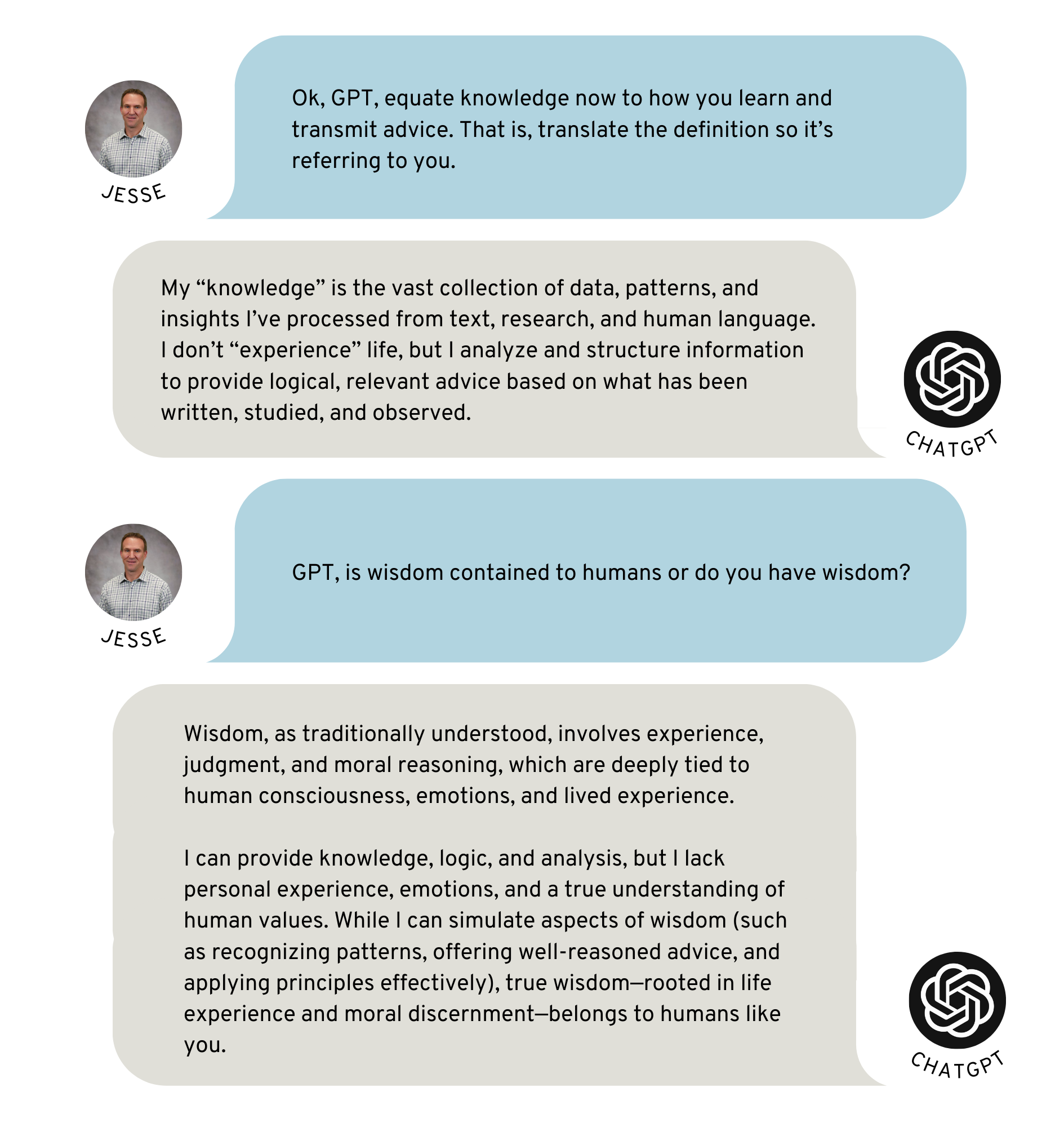
This led me conveniently to Ken’s comments, which allowed me to focus in on the matter. Ken stated that AI has knowledge and humans have wisdom. AI = knowledge. Humans = wisdom. In Ken’s words, “AI is a world-class aggregator of knowledge.” I, again, tend to agree here with Ken. I thought what better way to integrate this theory into practice than to pull in GPT for some help. I asked GPT to define advice. I ended up on a hamster wheel with GPT; I’ll spare you the details. In essence, advice is an opinion offered to guide an action; counsel. In looking up guidance and counsel, it was a circular loop among the three: Advice=counsel=guidance. 

“Ok, GPT, let’s go another direction, tell me about
the ingredients, knowledge, and wisdom.”

The Cambridge English Dictionary defines:

  • Knowledge: “Awareness, understanding, or information that has been obtained by experience or study.”
  • Wisdom: “The ability to make good judgments based on what you have learned from your experience.”

Oh my, Knowledge seems to require some rather human elements. Wisdom makes sense as it relates to people like our experienced elder, Dave.

Thanks, I thought, for the shoutout. As usual, a bit wordy, but thank you. As I understood it, we basically have our minds, actions, and emotions that shape us and help us shape others.

This brings me back to Evan’s questions to GPT, “Is there good debt?”

To which GPT said yes. However, if consulting wisdom, there might be some important eye-to-eye pre-qualifying and reflective questions. “I don’t know, Evan, would you say you are good with debt and why?” “Tell me about yourself.” “What’s your family history with debt?” “How does debt make you feel?” “Are you positioning questions to get the answer you want or need?” “Do you feel debt helps build your character, improve the quality of your life or firm up your value system and why? “
On to the Debt Avalanche. This was the advice for our listener, Evan, according to GPT. This was very enlightening. At this point, with a more thorough appreciation for how important it is for the inquiree to get to know the inquirer, I realized I’ve yet to have GPT ask me, “Tell me about you before I answer this.”
Okay, so are motivation, energy, and reward systems important factors? Well, let’s say our (assumed) 20-something Evan will use the Debt Avalanche. Will Evan be guided more LIKELY by emotion, the short term, little wins, and crossing off debtors, or by keeping in focus the interest saved at the end of the long-term race? I can only say I was. Again, I’d have to get to know Evan but I’d probably start by assuming the former. After some Avalanche time under his belt, will he feel coach GPT got to know him, to understand him, to empathize with him, to call audibles along the way?

At this point, I asked GPT to help a little bit more. GPT was again very capable and helpful, but I needed to use a little hard-earned wisdom to fine-tune what I myself might find more helpful. These are by no means limited, but it does help frame a clearer picture.

“GPT, given our conversation and context so far, please provide in descending order the top 5 characteristics that human advice and AI advice would excel at, respectively?”

Advice Through Humans
(Wisdom-Based)

  • Wisdom – You apply experience and judgment to unique human situations and shared values.
  • Empathy and Compassion – You feel and understand emotions and human complexities and help accordingly.
  • Persuasiveness Teach/Coach – You tailor advice to resonate and motivate to accomplish healthy, successful outcomes.
  • Integrity – You ensure ethical, value-driven recommendations and always, always seek the golden rule.
  • Relevance Priorities – You personalize advice to real-world needs like family, leaving a legacy, and contributing to your community.

Advice Through AI
(Knowledge-Based)

  • Objectivity – I provide unbiased, data-driven recommendations.
  • Clarity – I structure and simplify complex information.
  • Foresight – I predict outcomes based on patterns and probabilities.
  • Feasibility – I suggest logical, actionable strategies.
  • Timing – I deliver instant, context-aware responses.

I was really pleased with GPTs help and even more so with the clear distinction in strengths. But it dawned on me that the most important characteristic in advice did not come up, trust. Trust comes from relationships. Relationship with oneself and with others. The one thing I’ve learned in providing advice is that every relationship is as unique as the individual, a fingerprint, with no two alike. There are certainly broadly applicable knowledge-based solutions, but without the relationship, the advice can be (and in many cases is) flat-out wrong.

My Overall Thoughts

In summary, I agree even more with Dave and Ken now. AI is an astonishing advancement in delivering advice. In using it more, I see more of the stark differences between virtual advice and human advice, and how the answer can be both yes and no. The (integrated) whole can be far greater than individual sums. However, the order matters, the relationship more so, and the crucial participant, YOU, matters the most. There is no shortage of noise out there regarding AI and jobs, and the broad field of advice is no exception. Why doesn’t Dave have more on the subject and why doesn’t he seem more concerned? What does our wise elder know that we do not? Perhaps he has a more profound sense of optimism for how this amazing resource can enhance, not diminish, human advice. Personally, I’d probably get with Kirk, ask him to run it by Spock, and get back to me. This exercise certainly helped me, and I look forward to more. It helped clear up my own approach to seeking and providing advice. AI is an amazing jump in our potential to help change and transform lives for good.

Ready to connect with a human?

Your financial situation is unique. You need someone who understands what you’re going through. Click the button below to connect with a pro.